The beginner's guide to wakesurfing
Everything a first-time wakesurfer needs in one place — gear, boat setup, the get-up sequence, and the five mistakes that ruin everyone's first session.
Published April 20, 2026
Wakesurfing is the easiest action sport to look good at and one of the harder ones to actually learn. The hardest moment is the first 90 seconds — everyone bails three or four times before it clicks. After that, almost every rider learns to drop the rope on the same day. This guide walks you through everything from gear to wave shape so your first session isn’t a frustration loop.
What you actually need
- A surf-capable boat. That means a v-drive inboard, a wake boat with surf-tab/Surf Gate, or an inboard you’ve ballasted heavy on one side. A boat with an outboard or sterndrive prop near the rider is not safe to wakesurf behind, full stop.
- A wakesurf board. Start with a high-volume surf-style board (something like the Liquid Force Rocket). Skim boards punish beginners.
- A surf rope, 20-25 ft, with a T-bar handle.
- A USCG-approved life jacket. We strongly recommend a comp-cut Type III like the Liquid Force Watson.
Boat setup before the first set
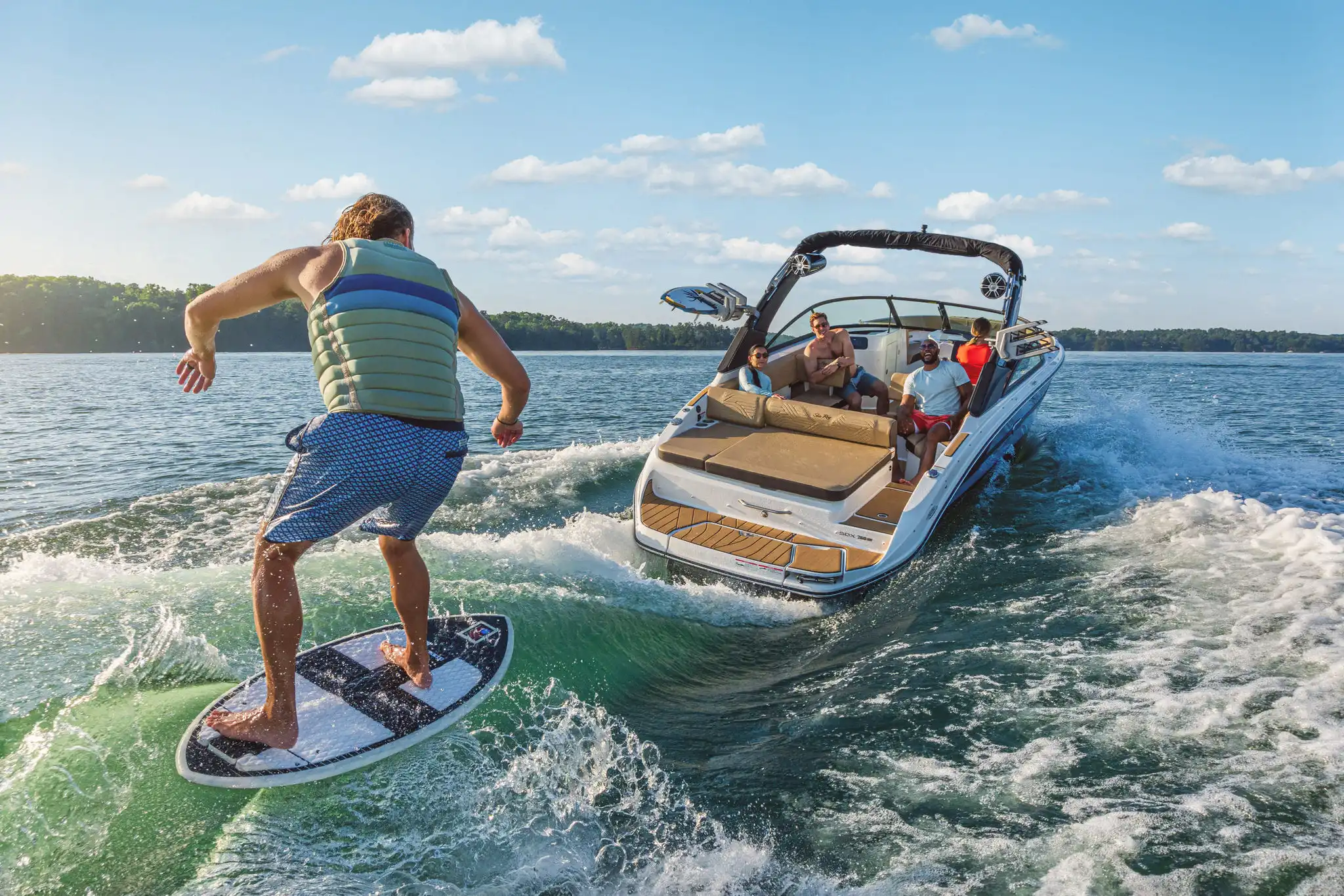
Get the boat heavy on one side. The “surf side” is whichever side you fill ballast on. Ballast roughly 1,200-2,000 lb on the surf side depending on boat size, set the speed at 10.5-11.5 mph, and engage your surf tab or Surf Gate / NSS / similar wave-shaper if your boat has one.
Run a rope length where the rider is just clear of the swim platform. Too short and the wave is washy; too long and the wave loses pocket.
The get-up sequence
- Float on your back, board sideways, heels resting on the rider-side rail. Feet shoulder-width.
- Hold the rope with both hands, arms straight, knees bent.
- Driver pulls slow. Rider’s job is to stay passive. Let the boat do the work.
- As the board comes under your feet, stand up tall — don’t try to “surf” yet.
- Once standing, lean slightly forward and let the board pivot toward the boat.
- Find the pocket — that fat green water just behind the wave’s peak — and stay there.
Drop the rope
You’re ready to drop the rope when you can stay in the pocket without pulling on the line. Test it: with the rope loose, are you accelerating toward the boat? Drop. Are you sliding back? Pump or move forward in your stance and try again.
Throw the rope over the boat-side gunwale, not into the water on your wake side. The driver should never have to circle to retrieve a rope that landed near a fallen rider.
The five mistakes that ruin first sessions
- Boat too fast. 13+ mph blows the wave out. Slow down.
- Rider standing too soon. Trying to skip the float-up phase puts the rope in front of your face during a crash. Stay passive until the board is under you.
- Wrong board. A skim board for a beginner is a recipe for spinouts. Stick with a surf-style.
- Wrong rope length. If the wave looks washy and small, shorten the rope.
- Driver oversteering. Tiny wheel inputs only. Big inputs collapse the wave.
Where to go from here
Once you can drop the rope and ride the pocket cleanly, the next two skills are pumping the board (generating speed without the rope) and carving up to the lip and back to the pocket. After that you’ll start playing with rotations and airs — read Surf-style vs. skim-style before you buy your second board.
Always wear a USCG-approved PFD. Always have a sober driver. Always check the area behind the boat before pulling away.